Julia Rayner on acting, directing and bringing Tyrant to life
By MetFilm School
16 October 2026
We sat down with Julia Rayner, an actor and filmmaker who has worked with some of the biggest names in the industry, including Roman Polanski, Tom Harper, Ricky Gervais, and Mike Leigh. Alongside her acting career, Julia has continued to develop her skills behind the camera, recently completing an MA in Directing at MetFilm School Leeds.
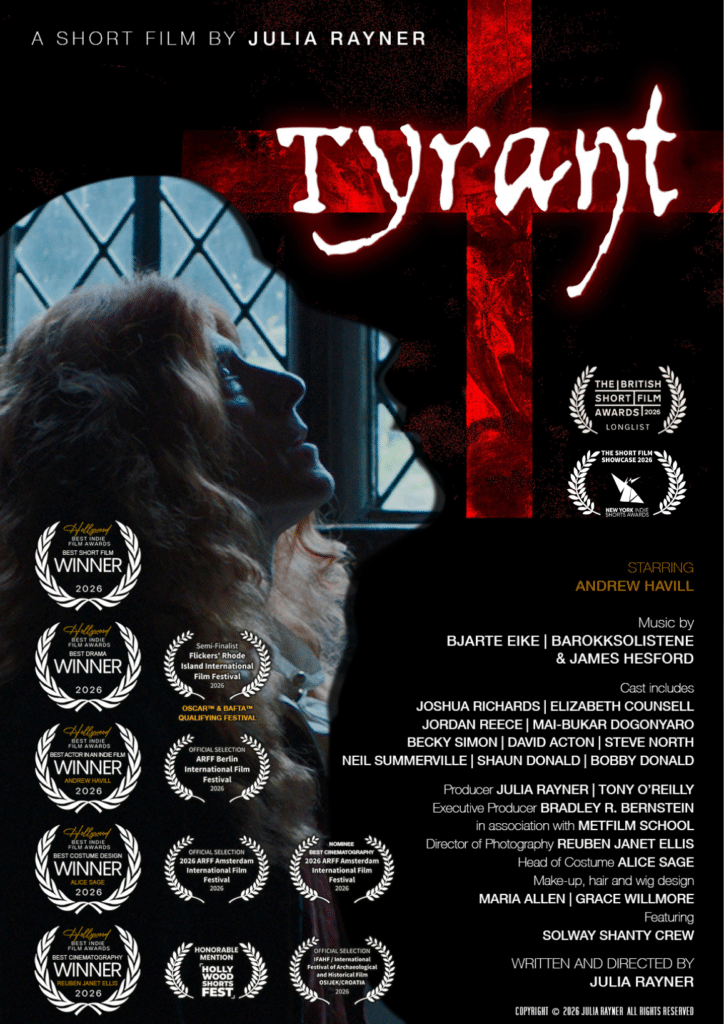
We spoke about what first inspired her to get into film, her experiences across acting, filmmaking, and directing, and the making of her short film Tyrant. Set in 17th-century England, the film follows King James II after he loses his crown and power, exploring the shifting dynamics of power, religious tensions, and the lives of those living under his rule. We also discussed the inspiration behind the story, Tyrant’s successful festival run, and its recognition along the way, including being longlisted for the British Short Film Awards.
What first inspired you to get into film and storytelling, and when did you realise you wanted to become a director?
I’ve always been fascinated by stories – hearing them and telling them! I loved listening to my grandfather recount tales by an open fire about his days working as a coal miner, and about finding footprints and fossils. I suppose, like most children, I saw stories as a magical way of interpreting the world. Although my toddler is the complete opposite – he loves facts, figures, and the solar system!
My passion grew from staging daily events in the playground to actually bringing them to life on stage. I honestly can’t remember a time when I wasn’t working on an idea in some shape or form.
The pandemic made me realise that I still hadn’t ticked the box of going to film school or fulfilled that long-standing yearning to get my ideas onto film. It was something I’d always wanted to do, and ultimately, filmmaking is my greatest passion. I felt incredibly lucky to be accepted onto the MA in Directing at MetFilm School Leeds as a mature student.
Having grown up in Leeds before moving away, it felt particularly special to return to the city to pursue this next chapter. My mum still lives here, so coming back and staying with her while studying made the experience all the more meaningful.
You’ve worked as an actor with directors including Roman Polanski, Mike Leigh, Tom Harper, and Ricky Gervais. What did you learn from those experiences that you now bring to your own work as a director?
I feel very fortunate to have worked with all four. They’re hugely different in their approaches, sometimes polar opposites, yet all are searching for the same thing: truth in every moment.
As an actor, you learn to adapt to each director’s method, and I think those experiences percolate somewhere deep in your subconscious. Hopefully, you filter through the good stuff, and it becomes instinctive when you step behind the camera.
I like being put on the spot and keeping things instinctual. All the directors I’ve worked with have had an extraordinary eye for detail, but Roman Polanski had a seemingly inbuilt radar for precision. Watching him work on The Pianist was a masterclass in attention to detail. He once physically took a door off its hinges and rehung it the other way because doors in wartime Poland would have opened differently. That level of detail has always stayed with me. It reminded me that authenticity often lies in the smallest things.

You’ve worked across acting, dance, theatre, writing and directing. How have those different experiences influenced the way you work as a filmmaker?
For me, it’s probably a combination of good preparation, experience and ultimately, intuition. I haven’t consciously analysed all the influences, so I suspect much of it has arrived by a process of osmosis!
My background in dance and choreography has been particularly influential when visualising a film – thinking about its rhythm and flow, the movement of the camera, and how people move through a space. I think all those different disciplines feed into one another, often without you even realising it. Ultimately, they’re all different ways of telling a story.
Looking back on your time studying for your MA in Directing at MetFilm School Leeds, how did that experience shape your approach to filmmaking?
What a course! I cannot recommend it highly enough.
I’d already directed two short films before joining, but I wanted to deepen my understanding of the technical side of filmmaking. I was keen to learn more about editing, operating the camera, and all the practical skills that would help me realise my ideas more confidently. The teaching was brilliant, and the staff were incredibly supportive.
Dr Paul Gormley heads up a wonderful team, and I felt very fortunate to be surrounded by people who genuinely wanted us to learn, experiment, and succeed.
It’s an intensive course, but that’s part of what makes it so valuable. It’s the perfect environment to experiment, make mistakes, and push yourself well beyond your comfort zone.
You’re learning something new every day, working as part of a team and developing the discipline to keep going, even when things get challenging. You come away with a much stronger understanding of the craft and, importantly, the confidence to put what you’ve learnt into practice. You feel ready to hit the ground running.
Your latest short film, Tyrant, is set in 17th-century England. What inspired the story, and what made you want to bring it to the screen?
I used to live in Faversham, Kent, pretty much next door to the house where King James II was incarcerated in 1688. I used to park my car beneath a silver plaque marking the history of the place, and I’d often find myself wondering what had happened there.
I was fascinated by the story of James II, a Catholic king who found himself stripped of his crown and power. I’ve always been intrigued by the nature of power – how it operates at different levels of society, and how powerful figures, often men, have historically sat at the helm. It’s something that continues to resonate today.
Initially, I was drawn to the idea of James as an unrecognised man amongst ordinary people. What happens when the crown slips? Who are you when the very thing that defines you and gives you authority is suddenly taken away?
As I researched further, I discovered a more complex character than I had initially imagined, particularly in relation to his pursuit of religious toleration. I became interested in the contradictions within him, and in the way his position and beliefs affected those around him.
Although James is at the heart of Tyrant, we also see the world through the lives of those living beneath the weight of his power: a radical Protestant fisherman, the women looking after him, and an enslaved African man. Their experiences offer a different perspective on the religious tensions and social hierarchies of the time. Though I love period dramas, for me, Tyrant is as much about human nature and the shifting dynamics of power as it is about a particular moment in history.
You filmed Tyrant in some amazing historic locations, including Whitehaven Harbour, Bishops’ House, and East Riddlesden Hall. What was it like bringing their world to life in these places?
After a fair amount of persuading to get the venues on board, I honestly had goosebumps at every location. I couldn’t believe how lucky we were to be able to bring Tyrant to life in these extraordinary historic spaces. They felt like little treasure boxes, each with its own atmosphere and stories to tell.
At East Riddlesden Hall, we filmed in a room with a portrait of King James II looking down on us. It felt almost like a nod from him that we were on the right track!
Of course, every location brought its own gifts and challenges. We had plenty of post-production work to do, removing modern-day intrusions such as cars passing outside the windows and smoke alarms creeping into shots. It’s amazing what you can achieve with a little ingenuity in the edit!

How has it felt seeing Tyrant travel to festivals and receive recognition along the way, including being longlisted for the British Short Film Awards?
For everyone involved, I think it’s been a dream come true to receive this kind of recognition for a graduation film.
When you’re making a film, you’re so focused on getting everything done in time for your academic deadline that you don’t always have the headspace to think beyond it. To see Tyrant go on to collect festival laurels and awards has been incredibly encouraging, and we still have more of the festival circuit ahead of us.
Everyone worked so hard to bring this film together, and it’s wonderful to see the cast and crew receiving recognition for their efforts, too. I feel incredibly proud of what we’ve achieved together.
I’m also currently developing Tyrant into a feature-length screenplay, which is an exciting next step for the project. It’s wonderful to feel that the story still has more to give.
You worked with a great team on Tyrant, including fellow MetFilm School Leeds graduate Reuben Janet Ellis as cinematographer. What was it like bringing the film to life together, and what did you enjoy most about the collaborative process?
Reuben did a fantastic job as cinematographer on Tyrant, and it’s good to see his work receiving recognition, including at the Hollywood Best Indie Awards. He’s also a finalist for Best Cinematography at ARRF International Film Festival Awards in Berlin this November, where Tyrant is up for Best Student Film.
It was wonderful to have so many fellow students come on board and support the project. That sense of collaboration and generosity from your peers makes such a difference when you’re bringing a film to life.
Our mentor and tutor, director Andrew Gunn, was also a tremendous help, guiding us in the right direction with his knowledge and expertise.
I particularly loved working with M.B Dogonyaro, a BA Acting student who played Billy Williams. The film school is doing a brilliant job of preparing actors for working in front of the camera, and he’s definitely one to watch. When I was starting out, you often turned up on set, tried not to look at the camera, and hoped for the best! It’s wonderful to see how much more prepared young actors can be now.

Looking back on your career so far, what advice do you have for aspiring filmmakers?
Look, it can be a tough industry at times, but it can also be wonderful, exciting, and incredibly rewarding.
You need to develop a thick skin to deal with rejection and know that it’s par for the course. Try not to take it personally, but at the same time, keep a thin skin when it comes to the work itself. You need to remain open, curious, and receptive to what you’re doing.
Keep finding joy in your work, whatever it is – even if it’s just taking a selfie! Remember why you started in the first place, and be proud of what you’re achieving, however small it might seem at the time.
Listen to your heart, keep going, and trust that you’ll find your own way.
Inspired by Julia’s story?
Discover our MA Directing and advance your career as a director.
Come to an Open Day and meet our industry-active lecturers, and find out how you can gain real on-set experience while you study.